
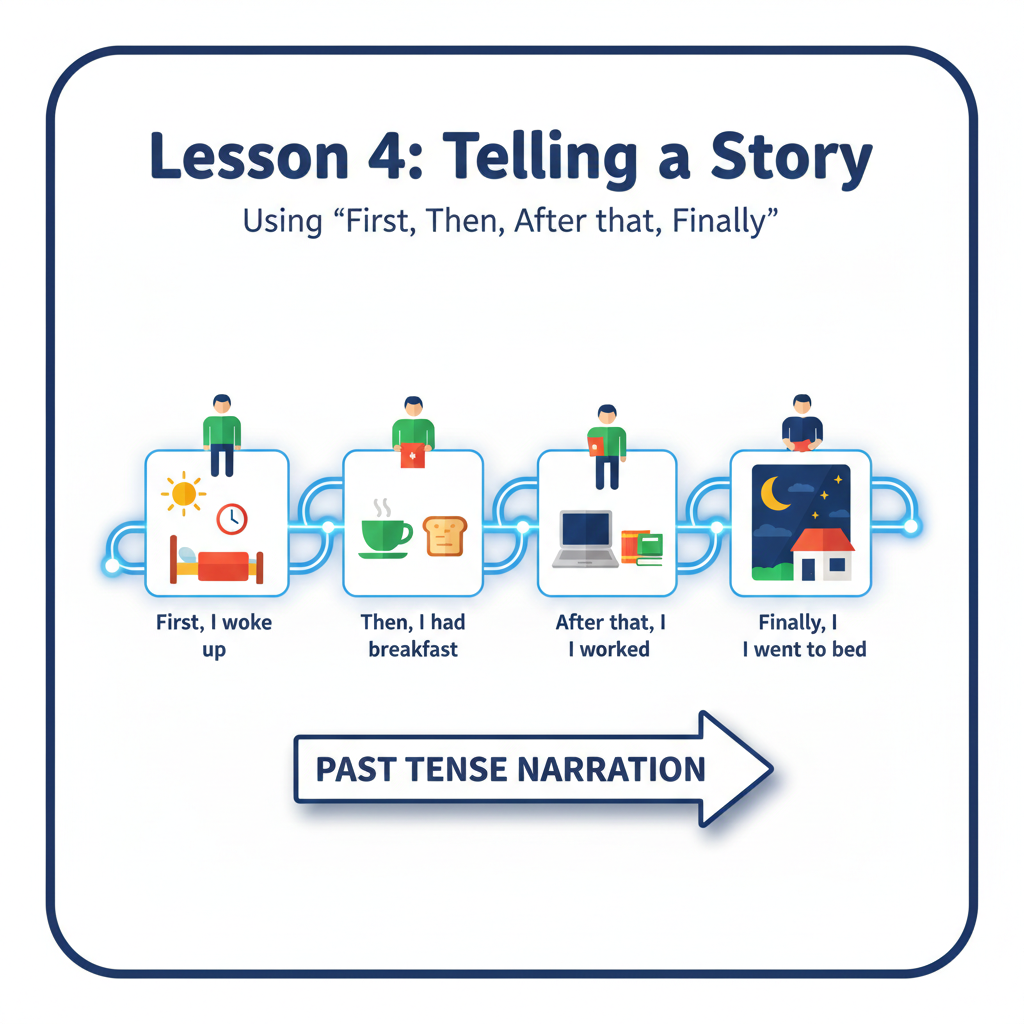
Lesson 4: Telling a Story
Using “First, Then, After that, Finally”
🎯 Lesson Goal
- Organize your ideas in a logical, chronological order.
- Connect separate sentences into a smooth narrative.
- Identify the difference between regular and irregular verbs in a real story.
🛤️ The Roadmap of a Story
In English, we use Sequence Markers to help the listener follow the timeline of our story. Without them, the story feels like a list of disconnected facts!
💡 Writing Tip: The Comma Rule
When you start a sentence with a sequence marker, always put a comma (,) immediately after it. This tells the reader to take a small pause.
✅ First, I woke up. (Correct)
❌ First I woke up. (Incorrect)
🎧 Activity 1: Listen and Repeat
Repeat these sentences out loud. Pay close attention to the pause after each comma:
🔊 Then, I watched TV.
🔊 After that, I cooked dinner.
🔊 Finally, I went to bed.
📚 Activity 2: Reading Practice
Read this short narrative. Notice how the sequence words turn four separate events into a story:
🔍 Activity 3: Story Analysis
“First, I woke up at 7:00 a.m. and drank a large glass of water. Then, I exercised for twenty minutes in my living room. After that, I cooked a healthy breakfast. Finally, I grabbed my bag and walked to the bus station.”
Exercised, Cooked, Grabbed, Walked
Woke up, Drank
✍️ Writing Challenge: Your Last Weekend
Using the sequence markers and your knowledge of past verbs, describe four things you did last Saturday:
Then, __________________________________________.
After that, ______________________________________.
Finally, _________________________________________.