
Script
Hi! I’m Marie Curie. In this lesson, we’ll learn how to talk about daily habits using the Present Simple. You’ll discover key verbs, build simple sentences, connect actions to time, and practice with real-life listening and reading. Let’s begin!
—End of video script—
Ready to Master Your Routine!
As Marie Curie mentioned, this lesson is your key to talking about your daily life. We’ll start by building your core vocabulary (the verbs) and then put them to work using the Present Simple tense. Focus on matching the verbs to your own day!
Part 1: Vocabulary & Visual Matching (The Core Verbs)
Study the phrases and images below. These are the most common things people do every day!
| Verb Phrase | Example / Audio | Image/Icon |
|---|---|---|
| Wake up | I wake up at 7:00 a.m. | 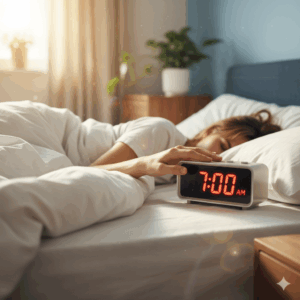 |
| Get up | I get up five minutes after I wake up. | 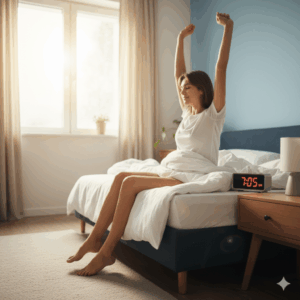 |
| Take a shower / Have a shower | I have a shower in the morning. | 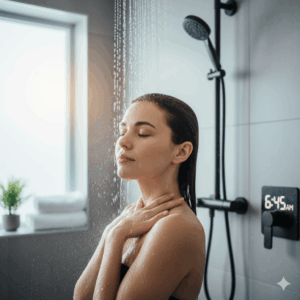 |
| Brush my teeth | I always brush my teeth before breakfast. | 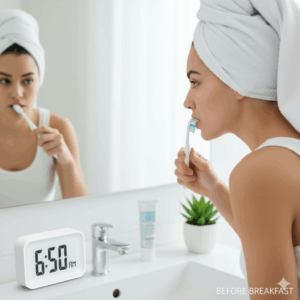 |
| Get dressed | I get dressed for work. | 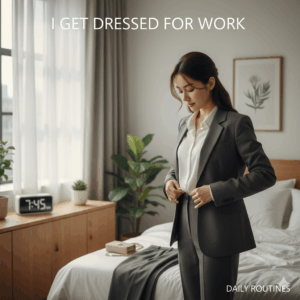 |
| Have breakfast | I have breakfast at 7:30 a.m. | 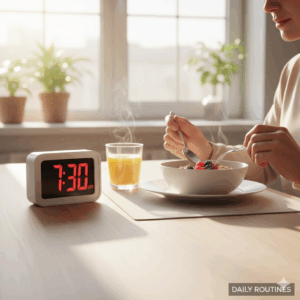 |
| Go to work / Go to school | I go to work by bus. |  |
| Have lunch | I have lunch at 1:00 p.m. | 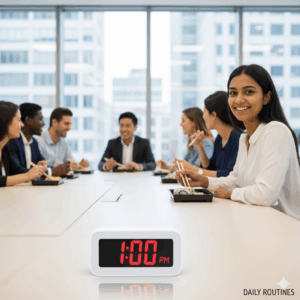 |
| Finish work / Finish school | I finish work at 5:00 p.m. |  |
| Go home | I go home after work. | 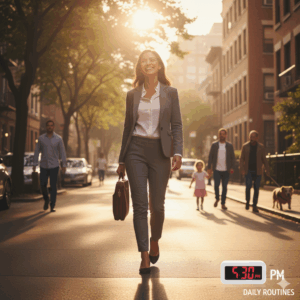 |
| Have dinner | I have dinner with my family. | 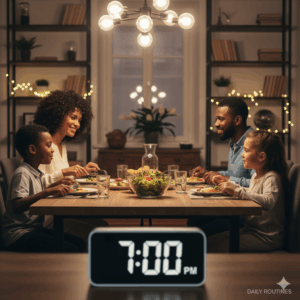 |
| Watch TV | I watch TV in the evening. | 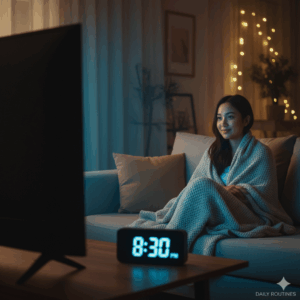 |
| Go to bed | I go to bed at 10:30 p.m. | 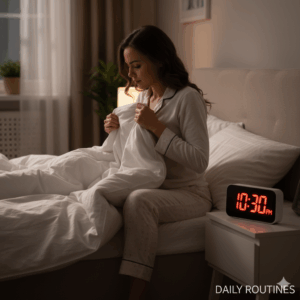 |
Part 2: Grammar Focus – The Present Simple (for Habits)
To talk about your daily routine—things you do regularly—we use the Present Simple tense. The verb form changes depending on the subject (who is doing the action).
| Subject Group | Subject | Verb Form Rule | Example of a Daily Routine Sentence |
|---|---|---|---|
| Group 1: Base Verb (No -s) | I | Use the base form of the verb (no -s). | I wake up at 7:00 a.m. |
| You | You brush your teeth before breakfast. | ||
| We | We have lunch at 1:00 p.m. | ||
| They | They go to bed at 10:00 p.m. | ||
| Group 2: Add -s (Regular verbs) | He | Add –s to most verbs. | He eats breakfast at 7:30 a.m. |
| She | She walks to school every morning. | ||
| It | It sleeps most of the day. | ||
| Group 3: Add -es (-ch, -sh, -x, -s, -o) | He | Add –es to verbs ending in -ch, -sh, -x, -s, -o. | He goes to work by bus. |
| She | She washes her face in the morning. | ||
| It | It passes the bakery every morning (e.g., the school bus). | ||
| Group 4: Change -y to -ies (Consonant + y) | He | Change –y to –ies for verbs ending in consonant + y. | He studies English every evening. |
| She | She carries her lunch to school. | ||
| It | It flies over the rooftops every morning. | ||
| Group 5: Irregular Verbs (has / does) | He | Use has instead of have, and does instead of do. | He has dinner with his family at 7:00 p.m. |
| She | She has a snack after school. | ||
| It | It has a nap after lunch. | ||
| He | He does his homework before dinner. |
Practice: Visualizing Sentences
| Example Daily Routine Sentence | Illustration |
|---|---|
| I wake up at 7:00 a.m. | |
| You have breakfast at 8:00 a.m. | 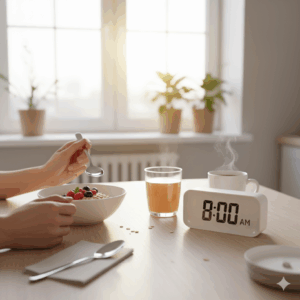 |
| We go to work/school every day. | 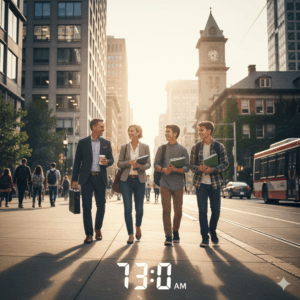 |
| They finish work at 5:00 p.m. | |
| He wakes up at 6:00 a.m. | 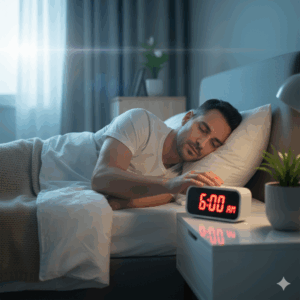 |
| She has dinner at 7:00 p.m. | 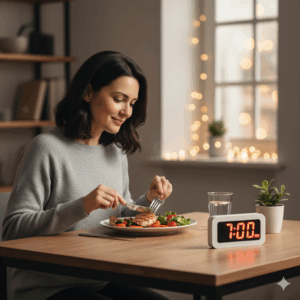 |
| It (e.g., the dog) sleeps most of the day. | 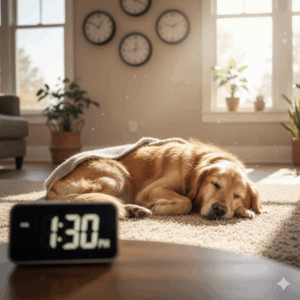 |
Part 3: Time & Sequence (Connecting the Day)
Telling Time with ‘at’
Use the preposition ‘at‘ before a specific time:
- I wake up at 7:00 a.m.
- She has lunch at 12:30 p.m.
Sequencing Events
To describe your day in order, use time expressions (adverbs of sequence):
| Time Expression | Example Sentence |
|---|---|
| First, | First, I wake up. |
| Then, / Next, | Then, I have a shower. |
| After that, | After that, I have breakfast. |
| Finally, | Finally, I go to bed. |
Part 4: Real-Life Listening & Reading
A Day in the Life of Amy – a Typical Daily Routine.
Listen and repeat:
My name is Amy. I have a busy routine every day. First, I wake up at 6:00 a.m. and I get up at 6:15 a.m. Next, I have a shower and get dressed. I usually have breakfast at 7:00 a.m. and go to work at 7:45 a.m. After that, I check my emails and start my tasks. I have lunch with my colleagues at 1:00 p.m. I finish work at 5:00 p.m. and go home. In the evening, I have dinner with my family. Finally, I watch TV or read a book, and I go to bed at 10:30 p.m.