
🎤 Audio Script
Hello, darlings! It’s Marilyn.
Today, let’s take a little stroll around town and learn some English.
It’s so glamorous to know your way around, don’t you think?
First, some lovely places. A bank, where you keep your jewels. A supermarket, for champagne and strawberries.
A park, for a romantic walk. And a hospital, though let’s hope we don’t need it!
Now, if you’re lost, just ask sweetly, “Excuse me, where is the park?”
Or, “How do I get to the bank?” It’s simple!
To give directions, you can say, “Go straight,” “Turn left,” or “Turn right.”
For example, “To get to the supermarket, go straight and turn right.
It’s next to the bank.” See? Easy peasy.
That’s all for today, my dears. Keep practicing, and you’ll be a star.
Kisses! Don’t forget to subscribe for more lessons.
Bye-bye
—End of Transcript—
Lesson Objectives
- Identify common places in a town (e.g., bank, supermarket, park, hospital).
- Ask and give simple directions using prepositions and landmarks.
- Use “Where is…?” and “How do I get to…?” in context.
Vocabulary: Places in Town
| Place | Icon | Example Sentence |
|---|---|---|
| Supermarket | 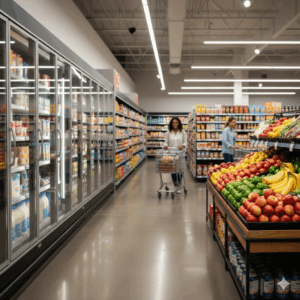 |
The supermarket is next to the bank. |
| Park | 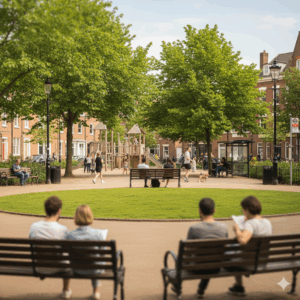 |
The park is behind the supermarket. |
| Hospital | 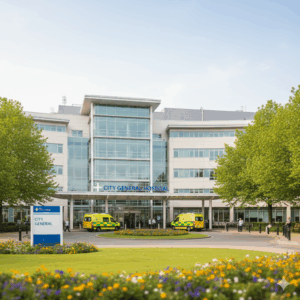 |
The hospital is across from the school. |
| Bank | 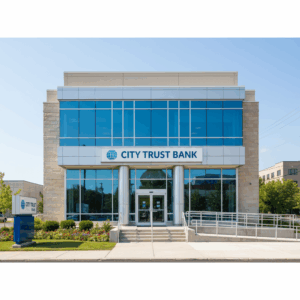 |
The bank is on Main Street. |
| School | 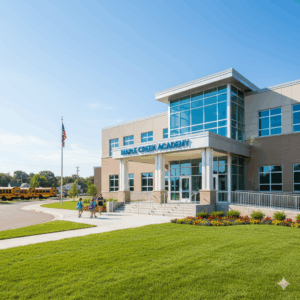 |
The school is near the library. |
| Library | 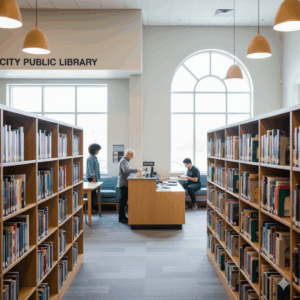 |
The library is behind the café. |
Grammar Focus: Prepositions of Location
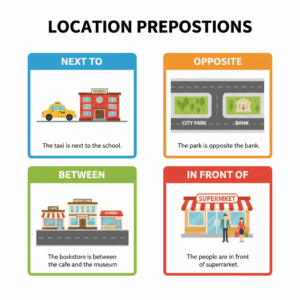
We use prepositions to say where something is in relation to another place.
| Preposition | Meaning/Use |
|---|---|
| next to | Immediately beside. |
| opposite | Across from (facing) on the other side of the road. |
| in front of | At the face side. |
| behind | At the back side. |
| between | In the space separating two places/things. |
Example: The café is next to the bank. / The park is opposite the school.
Asking for Directions (Polite Questions)
- Excuse me, where is… please?
Use: The most common and direct way to ask.
Example: Excuse me, where is the nearest bank, please?
Response ending: Thank you! - Could you tell me how to get to… please?
Use: A more polite way to ask.
Example: Could you tell me how to get to the hospital, please?
Response ending: Thank you! - How do I get to… please?
Use: Simple and clear.
Example: How do I get to the library, please?
Response ending: Thank you! - Is there a… near here, please?
Use: When you don’t know the exact location.
Example: Is there a good restaurant near here, please?
Response ending: Thank you!
Giving Directions
- Go straight. – Continue in the same direction.
Example: Go straight, please. The bank is at the end of the street.
Response ending: You’re welcome! - Turn left / Turn right. – Change direction.
Example: Turn right, please. The hospital is across from the school.
Response ending: You’re welcome! - It’s next to… – Immediately beside.
Example: The supermarket is next to the bank.
Response ending: You’re welcome! - It’s across from… – Directly opposite.
Example: The hospital is across from the school.
Response ending: You’re welcome! - It’s behind… – Place is at the back of another landmark.
Example: The library is behind the café.
Response ending: You’re welcome! - It’s between… – Place is in the middle of two landmarks.
Example: The park is between the school and the hospital.
Response ending: You’re welcome!
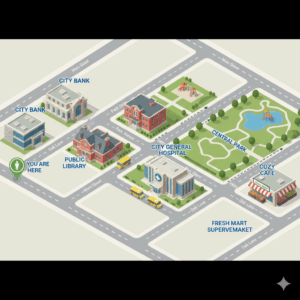
Map Practice: Asking & Giving Directions
Mini-Dialogue 1: Finding the Supermarket
Map Location: FRESH MART SUPERMARKET is on Park Street, near Park Avenue, opposite CENTRAL PARK.
A (Tourist): Excuse me, where is the supermarket?
B (Local): Sure! Walk down Park Street and cross Park Avenue. The supermarket is on your right, opposite the park.
Mini-Dialogue 2: Finding the Hospital
Map Location: CITY GENERAL HOSPITAL is on Park Avenue, near the Public Library and Oak Lane.
A (Tourist): Could you tell me how to get to the hospital, please?
B (Local): Of course. Go down Oak Lane and turn left onto Park Avenue. The hospital is just past the library, on your left.
A (Tourist): Past the library, on my left. Thanks!
Mini-Dialogue 3: Finding the Park
Map Location: CENTRAL PARK is on Park Avenue, opposite the Supermarket, near Park Street.
A (Tourist): Is there a park near here, please?
B (Local): Yes, Central Park is very close. Walk straight down Park Street. You’ll see it on your left, opposite the supermarket.
Mini-Dialogue 4: Finding the Library
Map Location: PUBLIC LIBRARY is at the corner of Oak Lane and Malt Street, next to CITY BANK.
A (Tourist): I’m looking for the library.
B (Local): The library? It’s right here — next to the bank, at the corner of Oak Lane and Malt Street. You’re standing in front of it!
🎧 Activity : Listening & Shadowing
Listen to the mini‑dialogues and repeat them aloud. Focus on pronunciation, rhythm, and polite phrases.