
Lesson Introduction: Prepositions
Prepositions are small but powerful words that connect nouns and pronouns to other words.
They help us talk about place (where something is), time (when something happens), and movement (how something moves).
In this lesson, you will learn the most common prepositions and practice using them in real conversations.
Lesson Objectives
- Understand the meaning and use of basic prepositions of place, time, and movement.
- Recognize prepositions in everyday questions and answers.
- Practice using prepositions in short dialogues and role‑plays.
- Build confidence in asking and answering with prepositions in real‑life contexts.
1. Prepositions of Place
Let’s look at three common prepositions of place: in, on, and at.
Use ‘in’ when something is inside or surrounded. I’m in a room, in a city, in a box.
Use ‘on’ for surfaces. My book is on the desk. My hat is on the shelf.
Use ‘at’ for specific points. I’m at the door, at the station, at the bus stop.
Now, let’s explore each one in more detail — with examples, visuals, and practice.
—End of Transcript—
Prepositions of place tell us where one thing is in relation to another. They are essential for clear communication about location.
| Preposition | Meaning & Grammar | Use and Examples | Illustrations |
|---|---|---|---|
| IN | Inside a three-dimensional space or container. | She lives in Spain. The milk is in the refrigerator. |  The pencil is in the cup. The pencil is in the cup.
|
| ON | Directly resting on the surface of something. | The picture is on the wall. My keys are on the counter. | 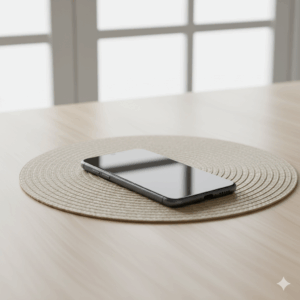 The phone is on the table. The phone is on the table.
|
| UNDER | Lower than something else, directly beneath it. | The submarine went under the water. We parked under the bridge. | 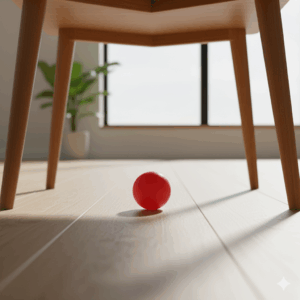 The ball is under the table. The ball is under the table.
|
| NEXT TO | Beside something; right near it. | She sat next to her best friend. The store is next to the bank. |  The pencil is next to the notebook. The pencil is next to the notebook.
|
| BEHIND | At the back of something. | What’s behind that door? He was hiding behind a tree. | 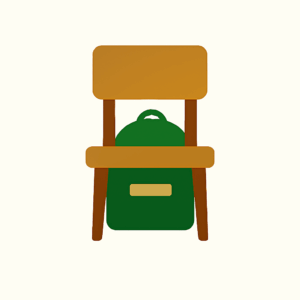 The backpack is behind the chair. The backpack is behind the chair.
|
| IN FRONT OF | At the forward part of something. | There’s a bus in front of us. She waited in front of the cafe. | 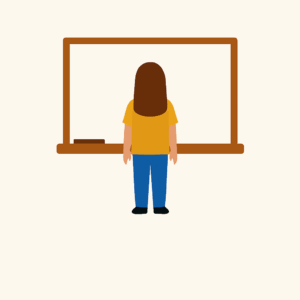 The student is in front of the whiteboard. The student is in front of the whiteboard.
|
| AT | A specific point or general vicinity. | I’m at work. She lives at 10 King Street. He’s waiting at the bus stop. | 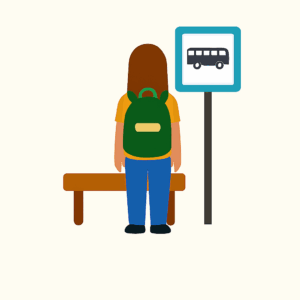 The student is at the bus stop. The student is at the bus stop.
|
📘 Quick Grammar and Use Notes
Placement
Prepositions usually come before a noun or pronoun (the object) to show its location.
Example: The book is on the table.
Phrases
Multi-word expressions like “in front of” and “next to” function as single prepositional units.
Example: The student is in front of the whiteboard.
IN vs. ON vs. AT — The Location Scale
Use this scale to understand how these prepositions describe location from largest to most specific:
- IN (The Largest Area or Volume)
Use for large spaces or when you’re surrounded by something.
Examples: in New York, in a pool, in a box - ON (The Surface)
Use for surfaces (floors, walls) or lines (streets, rivers).
Examples: on the roof, on Main Street, on the table - AT (The Specific Point)
Use for small, specific locations or when doing an activity there.
Examples: at the desk, at the door, at the bus stop
Literal vs. Abstract Use of “IN”
While in often implies physical enclosure (e.g., in a box, in a room), it also extends to abstract states where the idea of being “surrounded” is metaphorical:
- in trouble
- in love
- in pain
- in a good mood
These expressions don’t describe physical location, but rather a condition or emotional state.
“By” vs. “Beside”
In many everyday contexts, by can function as a synonym for beside, especially when describing physical proximity.
Examples Where “by” ≈ “beside”:
- The book is by the lamp. → Same as: The book is beside the lamp.
- She sat by me during class. → Same as: She sat beside me during class.
Subtle Differences
- Beside is more precise for spatial relationships and is often preferred in formal or instructional contexts (like ESL visuals).
- By is more versatile — it can also mean:
- Agent of action: The book was written by her.
- Method: He traveled by train.
- Deadline: Finish it by Friday.
2. Prepositions of Time
Hello students! Welcome to your beginner lesson on Prepositions of Time! Prepositions of time are small, crucial words that tell us when something happens. For this beginner level, we will focus only on the three most important prepositions: at, on, and in.
The Big Three: AT, ON, and IN
We use these three prepositions for different periods of time, moving from the most precise (at) to the most general (in).
| Preposition | Usage Rule | Example Phrase | Context Sentence |
|---|---|---|---|
| AT (Smallest Unit) | Specific, fixed points in time (clock time, noon, midnight, meals, night). | at 7:00 | I will see you at 7:00. |
| AT | Specific point | at noon | The office closes at noon. |
| AT | Specific point | at midnight | I will be there at midnight. |
| AT | Meal times | at lunchtime | Let’s meet at lunchtime. |
| AT | Night | at night | I study best at night. |
| AT | Holiday (general period) | at Christmas | We often travel at Christmas. |
| ON (Medium Unit) | Specific days and dates | on Monday | We have a meeting on Monday. |
| ON | Specific date | on August 15th | My birthday is on August 15th. |
| ON | Holiday with “Day” | on Christmas Day | We open gifts on Christmas Day. |
| ON | Special day | on your birthday | I will see you on your birthday. |
| ON | Day + part of day | on Friday morning | Do you want to join me on Friday morning? |
| ON | Weekend (US usage) | on the weekend | We are going to the mall on the weekend. |
| IN (Largest Unit) | Months | in December | I am getting married in December. |
| IN | Seasons | in summer | We can plan in the summer. |
| IN | Years | in 1985 | My parents met in 1985. |
| IN | Centuries | in the 1900s | The movies in the 1900s were amazing. |
| IN | General parts of the day | in the morning | I like to read in the morning. |
| IN | General parts of the day | in the evening | I enjoy walking in the evening. |
📘 Important Tips and Exceptions
- The Inverted Pyramid Concept:
- AT → Most specific, point-like time (7:00, noon, midnight, night).
- ON → Medium unit, flat surface (specific Day or Date).
- IN → Largest unit, enclosed space (Month, Year, Century, general parts of the day).
- Holidays: Use at for general holiday periods (at Christmas), but use on when the word “Day” is included (on Christmas Day).
- Parts of Day: Use in for general, longer periods (in the morning, in the afternoon, in the evening), but always use at for fixed points (at noon, at midnight, at night).
- Abstract Time: In is used for future/past references (in the past, in the future, in a moment).
- The Weekend: Both are correct depending on dialect:
- on the weekend → US usage
- at the weekend → UK usage
🎧 Shadowing Practice: Prepositions of Time (AT, ON, IN)
Use the short story in the following video to practice listening and speaking.
Repeat each sentence after you hear it. Focus on rhythm, pronunciation, and the use of at, on, and in.
Story Script:
- I wake up in the morning and get ready for school.
- My bus arrives at 7:30, so I leave home early.
- We have English class on Monday and on Wednesday.
- I eat lunch at noon with my friends.
- In the afternoon, we play soccer outside.
- My birthday is on August 15th, and we always have cake at night.
- We go shopping on the weekend, usually in the evening.
- I like to read books in summer, especially at Christmas when I stay home.
3. Prepositions of Movement and Direction
In this lesson, we’re focusing on five core prepositions of movement and direction: to, into, onto, out of, and off. These words describe the path an object or person takes from one point to another.
The Core Prepositions
| Preposition | Meaning / Function | Example Sentences | Illustrations / Notes |
|---|---|---|---|
| to | Movement towards a destination. | She walked to the grocery store. We drove to Florida for vacation. Please send the documents to my office. |
Shows the end point of movement. |
| into | Movement from the outside to the inside. | The kid jumped into the pool. He put the money into his wallet. We moved into our new apartment last week. |
Think of entering a confined space. |
| onto | Movement towards and reaching the surface of something. | The child climbed onto the chair. The dog jumped onto the bed. |
Implies dynamic motion to a surface. |
| out of | Movement from the inside to the outside. | She pulled her phone out of her purse. They walked out of the theater after the movie. We need to drive out of the parking garage. |
Opposite of into. |
| off | Movement away from the surface of something. | The ball rolled off the table. Please step off the escalator carefully. I took the wet towel off the hook. |
Opposite of onto. |
💡 Note: “On” vs. “Onto”
In American English, you will often hear on used instead of onto when describing the final placement of an object, especially with verbs like put or place.
| Usage | Focus | Example |
|---|---|---|
| Movement Focus (General) | Emphasizes the transition to the surface. | The dog jumped onto the sofa. |
| Placement Focus (Common in AE) | Emphasizes the result (where it is now). | She put the keys on the counter. |
| Movement Focus (Still Correct) | Stresses the motion. | She placed the books onto the high shelf. |
Key Difference: Since onto always implies movement, it’s required when the action is dynamic (e.g., jumped onto, climbed onto). When the verb itself already implies movement (e.g., put, placed), on is frequently used because the action verb carries the weight of the motion.
🎧 Shadowing Practice
Use the short story in the video below to practice listening and speaking.
Repeat each sentence after you hear it. Focus on rhythm, pronunciation, and how each preposition shows movement.
Story Script:
- I walk to school every morning.
- I go into the classroom and sit down.
- The dog jumps onto the sofa and sleeps.
- At lunch, I go out of the building with my friends.
- Then I jump off the steps and run to the park.
4. Asking and Answering with Prepositions
In this section, we’ll learn how to ask and answer questions using prepositions of place, time, and movement.
Common Question Patterns
| Question Type | Example Question | Example Answer |
|---|---|---|
| Place | Where is the pen? | It’s under the chair. |
| Place | Where’s the book? | It’s on the table. |
| Place | Where is the teacher? | She’s in front of the board. |
| Time | What time is the class? | It’s at 10:00. |
| Time | When is your birthday? | It’s on July 4th. |
| Time | When do you travel? | Usually in December. |
| Movement | Where are you going? | I’m going to the library. |
| Movement | Where did she go? | She went into the classroom. |
| Movement | What did the dog do? | It jumped onto the bed. |
| Movement | What happened? Where did they go? | They ran out of the house. |
| Movement | What happened to the ball? | It rolled off the table. |
Dialogue: “Getting Ready for Class”
Characters:
• Anna (student)
• Leo (student)

Anna: Hey Leo, do you know where the math book is?
Leo: Yeah, it’s on the teacher’s desk, next to the laptop.
Anna: Thanks! I thought it was under the chair.
Leo: Nope, I saw Mr. Gomez put it onto the desk this morning.
Anna: Got it. And what time is the class?
Leo: It starts at 10:00, right after recess.
Anna: Okay. I’ll go into the classroom now and get ready.
Leo: Wait! Don’t forget your notebook. It’s in your backpack, behind the water bottle.
Anna: Oh, thanks! I almost left it. Let’s walk to the classroom together.
Leo: Sure. I just need to take my phone out of my locker first.
Anna: No problem. I’ll wait in front of the door.
Prepositions Used
- Place: on, under, next to, behind, in, in front of
- Time: at, after
- Movement: onto, into, to, out of
Lesson Summary
By the end of this lesson, you can:
- Use prepositions of place to describe where things are (on, in, under, next to, behind, in front of, at).
- Apply prepositions of time to talk about when events happen (at, on, in).
- Recognize and use prepositions of movement and direction to describe actions (to, into, onto, out of, off).
- Ask and answer questions naturally with prepositions in everyday contexts.
Keep practicing with dialogues and role‑plays to make prepositions a natural part of your English communication!
Unit 2 Complete!
Amazing work! You have finished Lessons 11, 12, 13, and 14. You now know how to talk about time, numbers, and more. Are you ready for the final check of Unit 2? Click below!