
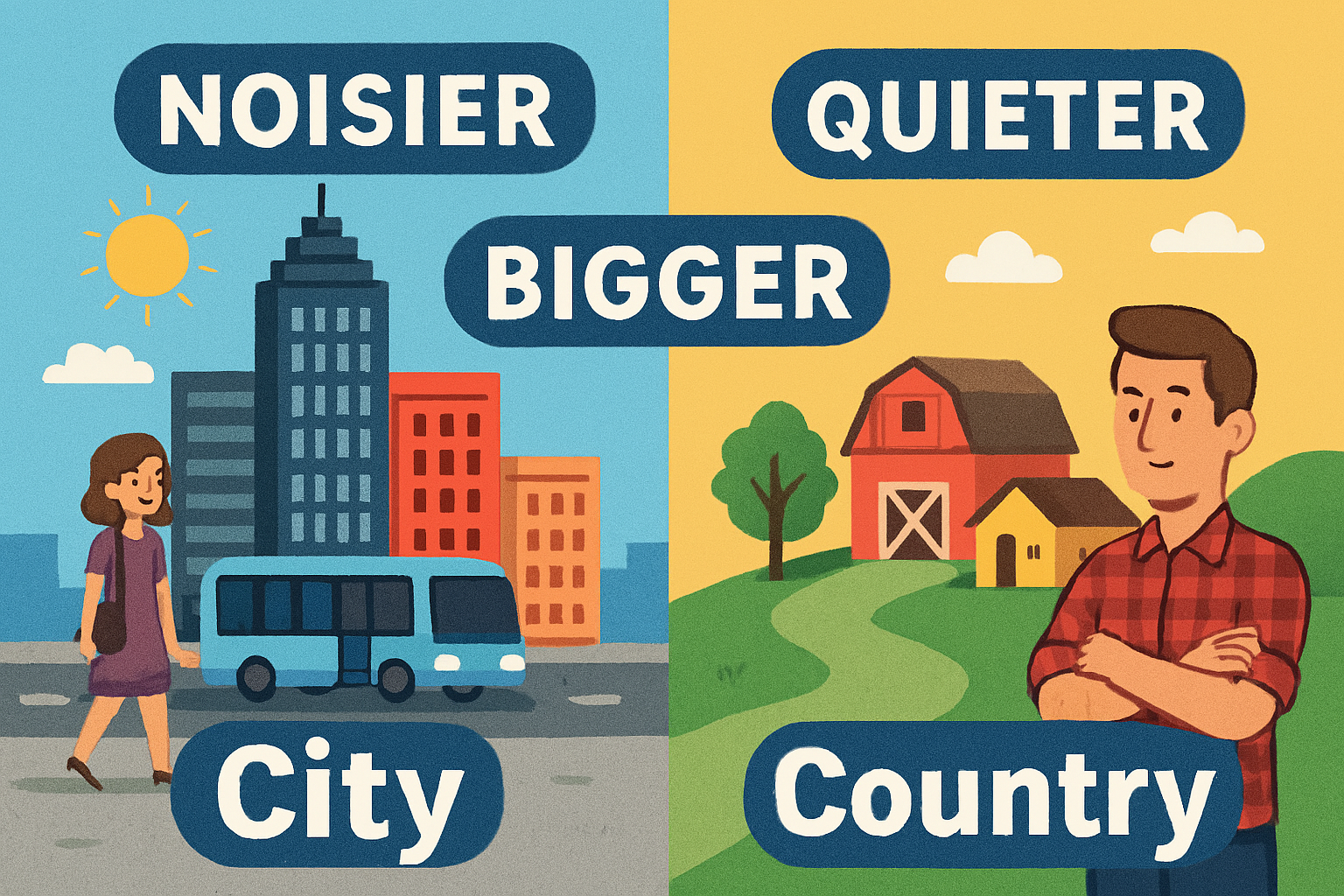
Lesson 13: Bigger and Better
Comparative Adjectives (City vs. Country)
English A2 – Pre-Intermediate | Unit 4: Comparisons and Work Life
🎯 Lesson Goals
- Learn how to form and use comparative adjectives.
- Practice comparing city life and country life.
- Develop critical thinking through guided discovery and error correction.
🔍 Guided Discovery
Read the two opinions below. Notice how the speakers use adjectives to highlight differences.
“I love London. It is noisier than my village, but it is more exciting. The shops are bigger and the transport is better. Living here is more expensive, but the opportunities are greater.”
“The city is more crowded. My life in the country is cleaner and more peaceful. The streets are narrower, but the air is healthier. It is safer for my children to play outside.”
📐 Grammar Focus: Comparative Logic
How do we build a comparison? Follow the syllable count of the adjective:
| Rule Type | Sentence Example |
|---|---|
| Short (1 Syllable) Add -er |
“The train is faster than the bus.” |
| CVC Rule Double consonant + er |
“New York is bigger than Dublin.” |
| Ending in -y Change y to -ier |
“The city center is busier on weekends.” |
| Long (2+ Syllables) More + Adjective |
“Paris is more expensive than Prague.” |
| Irregular Special forms |
“The weather is worse today than yesterday.” |
🤔 Why are some adjectives “Flexible”?
You may notice words like simple, narrow, polite, or friendly can use both rules. This usually happens because these words sit on the “syllable border”—they are short enough to take -er, but long enough to sound correct with more.
| Adjective | Option 1 (-er) | Option 2 (more) |
|---|---|---|
| Simple | Simpler | More simple |
| Narrow | Narrower | More narrow |
| Polite | Politer | More polite |
| Friendly | Friendlier | More friendly |
*Tip: Usually, adjectives ending in -le, -ow, -er, and -ure allow both forms.*
🗣️ Language in Use: The Great Move
Tom: Sarah! I heard you’re moving. Is your new house bigger than your flat?
Sarah: Much bigger! And the garden is prettier too. The city is just getting busier every year.
Tom: That’s true, but the commute to work will be further for you, right?
Sarah: Yes, it’s longer, but the train is more comfortable than the crowded subway. Plus, the air is better for my health.
Tom: I agree, but I think the city is more exciting. Living in a village seems simpler, but maybe more boring?
Sarah: Not at all! It’s just more peaceful. My stress levels are already lower!
💬 Your Turn
Using the dialogue above as a model, write three sentences comparing your current job or hometown to another one you know.
🎙️ Shadowing Practice: Two Worlds
Focus on the stressed words in bold. Speak along with the text to improve your rhythm.
“Living in a city is FASTER and MORE STRESSFUL than living in the country. The streets are MORE CROWDED, and the buildings are TALLER. However, the country is QUIETER and the food is FRESHER. For me, the country is BETTER because life is SIMPLER and the people are FRIENDLIER.”