
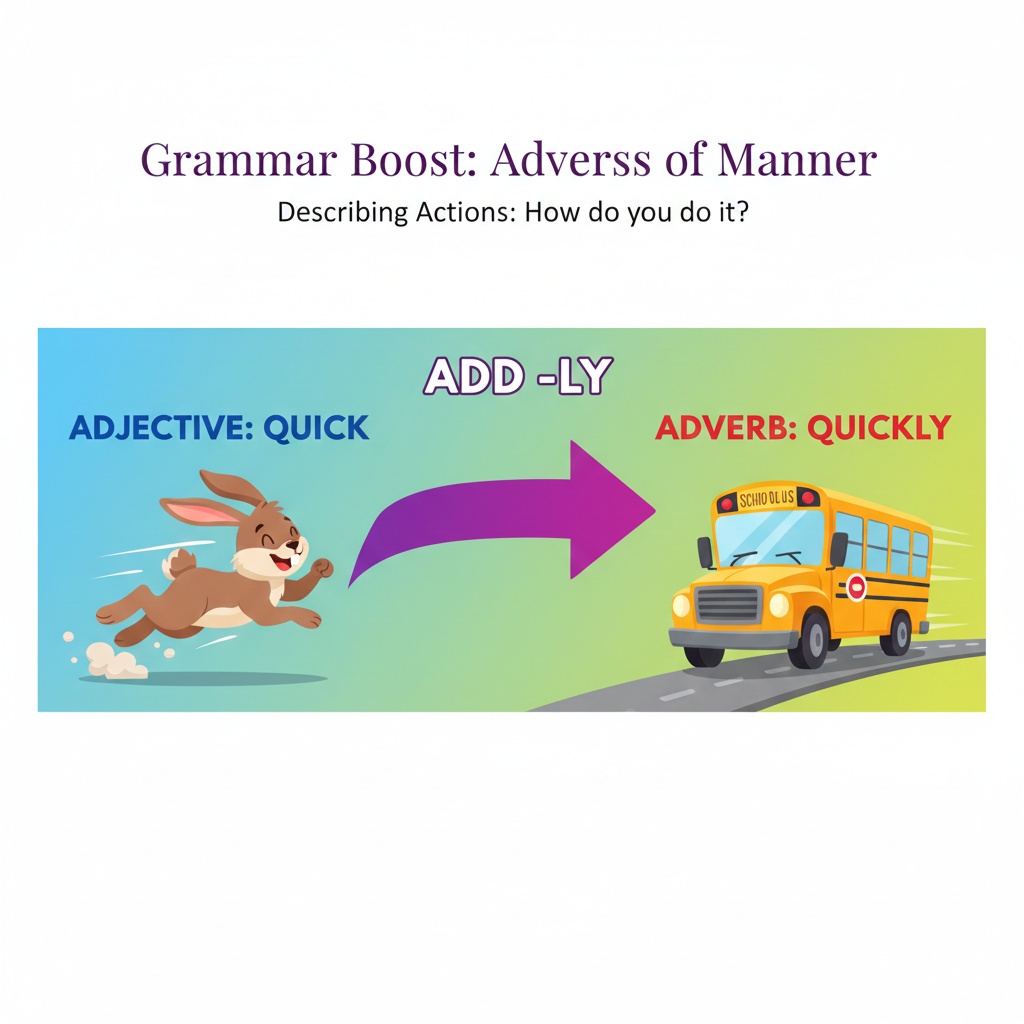
Grammar Boost: Adverbs of Manner
Describing Actions: How do you do it?
🤔 Adjective or Adverb?
We use Adjectives to describe people (nouns).
We use Adverbs to describe actions (verbs).
Adjective (Noun)
“He is a quiet boy.”
Adverb (Verb)
“He speaks quietly.”
🛠️ How to form Adverbs
For most words, just add -ly to the adjective:
| Adjective | Adverb |
|---|---|
| Quick | Quickly |
| Slow | Slowly |
| Loud | Loudly |
| Careful | Carefully |
⚠️ The Irregulars
Some words don’t follow the -ly rule. You must memorize these!
- Good ➔ Well (“She plays piano well.”)
- Fast ➔ Fast (“He runs fast.”)
- Hard ➔ Hard (“They work hard.”)
🔦 Spotlight: Bad vs. Badly
Even though “Badly” follows the regular -ly rule, it is often confused with the adjective “Bad.”
Use BAD (Adjective)
To describe a feeling or a thing.
“I feel bad about the mistake.”
“This is a bad movie.”
Use BADLY (Adverb)
To describe how an action was performed.
“The team played badly yesterday.”
“He sings very badly.”
📝 Challenge: Fix the Sentences
Choose the correct word for each sentence:
- Please listen (careful / carefully) to the teacher.
- She is a (good / well) student.
- My brother drives very (fast / fastly).
- He sings (beautiful / beautifully).
- The chef cooks (bad / badly).