
Video Script
There are two common ways of telling the time.
First way: Say the hour first and then the minutes.
For example: It’s seven twenty-five, it’s nine O-five (the O is said like the letter O), it’s ten eleven, it’s four thirty-six, and so on.
Second way: Say the minutes first and then the hour.
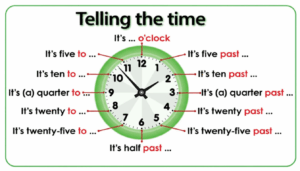
For example: It’s twenty-five to six, it’s five to three, it’s twenty past eleven, it’s eighteen past four, and so on.
For minutes 1-30 we use PAST after the minutes.
For minutes 31-59 we use TO after the minutes.
—End of Script—
In this lesson, you will learn:
- Two ways to tell the time: Digital (hour + minutes) and Analog (minutes + hour).
- How to use past and to for minutes.
- Special expressions: quarter past, quarter to, noon, and midnight.
- Parts of the day: morning, afternoon, evening, night.
- How to ask and answer about the current time, habits, events, and duration.
Two Ways to Tell the Time
Method 1: Hour + Minutes (Digital Style)
Say the hour first, then the minutes.
| Digital Time | Spoken Form |
|---|---|
| 7:30 | It’s seven thirty |
| 9:05 | It’s nine O-five |
| 10:11 | It’s ten eleven |
| 4:36 | It’s four thirty-six |
| 6:00 | It’s six o’clock |
| 12:45 | It’s twelve forty-five |
Method 2: Minutes + Hour (Analog Style)
Say the minutes first, then the hour.
| Analog Time | Spoken Form |
|---|---|
| 1:15 | It’s (a) quarter past one |
| 2:30 | It’s half past two |
| 3:45 | It’s a quarter to four |
| 4:05 | It’s five past four |
| 5:50 | It’s ten to six |
| 6:20 | It’s twenty past six |
Note on Time Expressions in American English
In American English, we use specific phrases to talk about time clearly and naturally. Here are some important conventions:
🕒 Quarter Expressions
- “It’s a quarter past seven.” (= 7:15)
- “It’s a quarter to five.” (= 4:45)
While some speakers may drop the “a,” the full form is more widely accepted.
🕛 Noon and Midnight
- Noon = 12:00 PM → “The meeting is at noon.”
- Midnight = 12:00 AM → “The flight leaves at midnight.”
These terms are preferred over “twelve PM” or “twelve AM” to avoid confusion.
Parts of the Day
| Time Phrase | Approximate Time | Example Sentence |
|---|---|---|
| in the morning | 12:00 AM – 11:59 AM | I check my email in the morning. |
| at noon | 12:00 PM | We usually have lunch at noon. |
| in the afternoon | 12:01 PM – 5:59 PM | She studies in the afternoon. |
| in the evening | 6:00 PM – 8:59 PM | We go for a walk in the evening. |
| at night | 9:00 PM – 11:59 PM | He watches movies at night. |
| at midnight | 12:00 AM | The train arrives at midnight. |
Tip: Use “in the…” for general time periods, and “at…” for specific times.
Talking About Time — Asking, Answering, and Understanding
In this lesson, you will learn how to ask and answer questions about time in real-life contexts, using both analog and digital formats.
Asking for the Current Time
We ask for the time using polite questions:
- “What time is it?”
- “Do you have the time?”
- “Could you tell me the time, please?”
We answer using analog or digital forms:
- “It’s a quarter past three.” (analog)
- “It’s three fifteen.” (digital)
Q&A Practice: Current Time
Student A: Excuse me, what time is it?
Student B: It’s a quarter to five.
Student A: Do you have the time?
Student B: Yes, it’s six thirty.
Student A: Could you tell me the time, please?
Student B: Sure — it’s ten past two.
Asking About Habits and Routines
We ask about daily habits using:
- “What time do you wake up?”
- “What time do you eat lunch?”
- “What time do you go to bed?”
We answer with at + time:
- “I wake up at six o’clock.”
- “I eat lunch at twelve thirty.”
- “I go to bed at ten fifteen.”
Q&A Practice: Habits
Student A: What time do you get up?
Student B: I get up at seven o’clock.
Student A: What time do you start work?
Student B: At eight thirty.
Student A: What time do you go to sleep?
Student B: At ten fifteen.
Asking About Scheduled Events
We ask about events using:
- “What time does the class start?”
- “What time is the meeting?”
- “When is the appointment?”
We answer with at + time:
- “The class starts at nine o’clock.”
- “The meeting is at two fifteen.”
- “The appointment is at four thirty.”
Q&A Practice: Events
Student A: What time is the movie?
Student B: It’s at seven o’clock.
Student A: When does the bus arrive?
Student B: At five forty-five.
Student A: At what time is the test?
Student B: At eight thirty.
Asking About Duration
We ask about how long something lasts using:
- “How long is the class?”
- “How long does the movie last?”
- “How long is the flight?”
We answer with for + duration:
- “The class is for one hour.”
- “The movie lasts for two hours.”
- “The flight is two hours and fifteen minutes.”
Q&A Practice: Duration
Student A: How long is the lesson?
Student B: It’s one hour.
Student A: How long does the movie last?
Student B: Two hours and ten minutes.
Student A: How long is your break?
Student B: Fifteen minutes.