
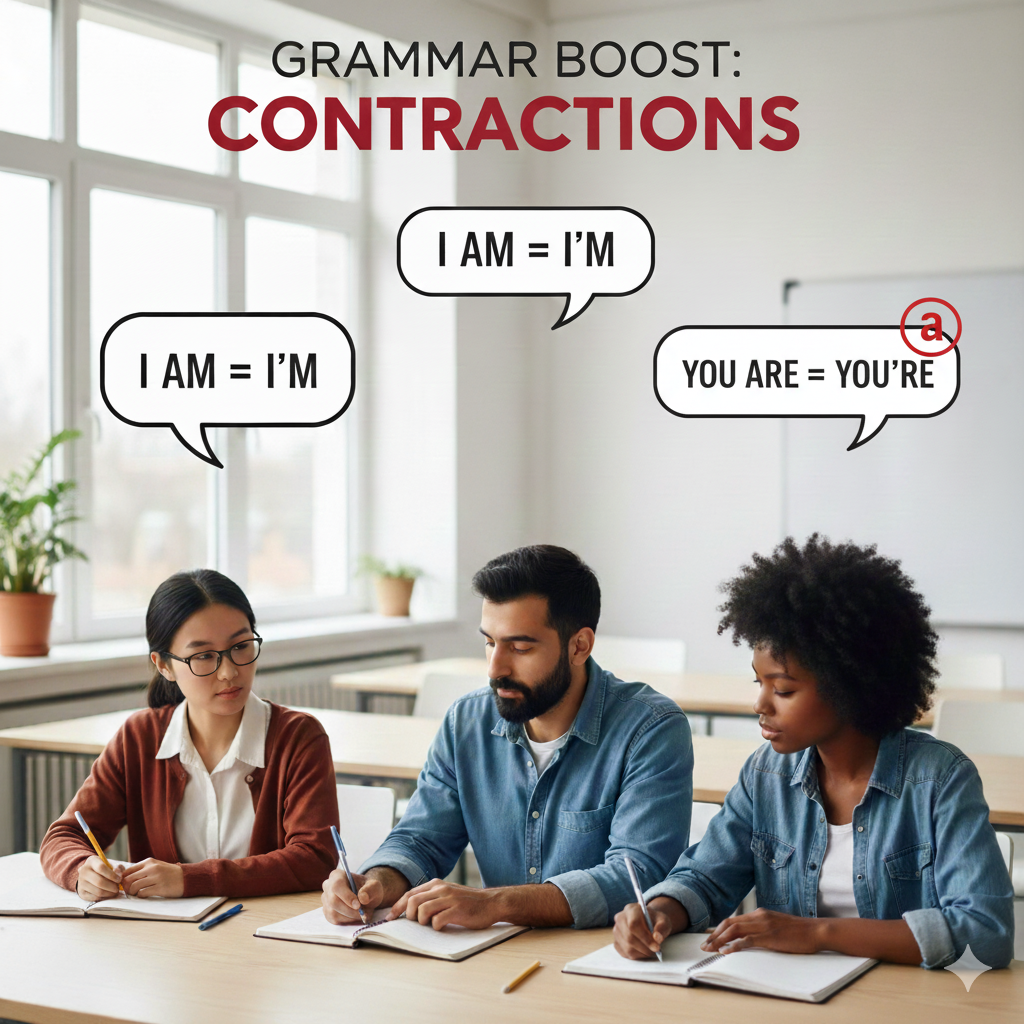
This section teaches you the short forms of the verb ‘to be‘ that are common in spoken and informal written English. Learning these forms will make your English sound more natural.
1. Lesson Goals
- Recognize and use the contracted forms of the verb ‘to be‘ (e.g., I am → I’m).
- Understand where to use the apostrophe (‘) when forming contractions.
2. The Contraction Rule
A Contraction is the combining of two words into a shorter form, often using an apostrophe ( ‘ ) to replace the missing letter(s).
Example: I + am = I’m
3. Positive Contractions
Use these short forms when speaking about identity, feelings, or origin (Lessons 3-6).
| Subject + Verb (Full Form) | Contracted Form | Example Sentence |
|---|---|---|
| I am | I’m | I’m American. |
| You are | You’re | You’re happy. |
| He is | He’s | He’s my teacher. |
| She is | She’s | She’s from Brazil. |
| It is | It’s | It’s a red pen. |
| We are | We’re | We’re students. |
| They are | They’re | They’re tired. |
4. Negative Contractions
Negative contractions are formed by combining the verb ‘to be‘ with not.
| Verb + Not (Full Form) | Contracted Form | Example Sentence |
|---|---|---|
| is not | isn’t | He isn’t Canadian. |
| are not | aren’t | We aren’t late. |
| am not | (No common contraction) | I am not tired. |
5. Pronunciation Practice
Listen to each sentence and repeat aloud. Focus on the rhythm and the way the contraction blends naturally:
| I’m ready. | |
| You’re here. | |
| He’s my friend. | |
| We’re learning. | |
| They’re excited. |
6. Mini-Dialogue with Contractions
| Student: I’m Ana. You’re my teacher, right? | |
| Teacher: Yes, I’m your teacher. We’re going to learn together. |
This short conversation shows how contractions make speech sound friendly and fluent.
7. 🎤 Shadowing Challenge
Now it’s your turn. Listen to each sentence and **repeat it aloud**, matching the speaker’s rhythm and stress:
| I’m a student. | |
| You’re curious. | |
| He’s ready. | |
| We’re learning. | |
| They’re excited. |
Remember: Repeat each sentence several times until it feels natural. This practice helps you sound more like a native speaker.